
Guided owner tour · 6 steps
Review your agency's financial performance
Start where Keelridge starts the owner: the Monthly brief. Then follow profit and plan into the book behind the result, and check that the book and the ledger agree. Every screen below is from the fictional demo agency, as of September 30, 2026, and each figure keeps its source and period.
KEELRIDGE SOFTWARE · REVIEWED · Screens come from a fictional, read-only agency.
 Owner viewOpen this page in the live demo →
The short answer
Start with the brief. Follow the figures. Settle the questions.
How did the month go?
The Monthly brief gives the verdict, profit against last year and where the year is heading against the plan.
What sits behind the result?
Open the P&L, the book's growth, retention and the Book vs GL comparison. Ask follow-up questions of the Keelridge Assistant.
What should the meeting settle?
The brief ranks the questions. Your people decide what happens next, within their roles.
Start with the Monthly brief.
Where: Agency Performance, Monthly brief. It is the first page an owner sees.
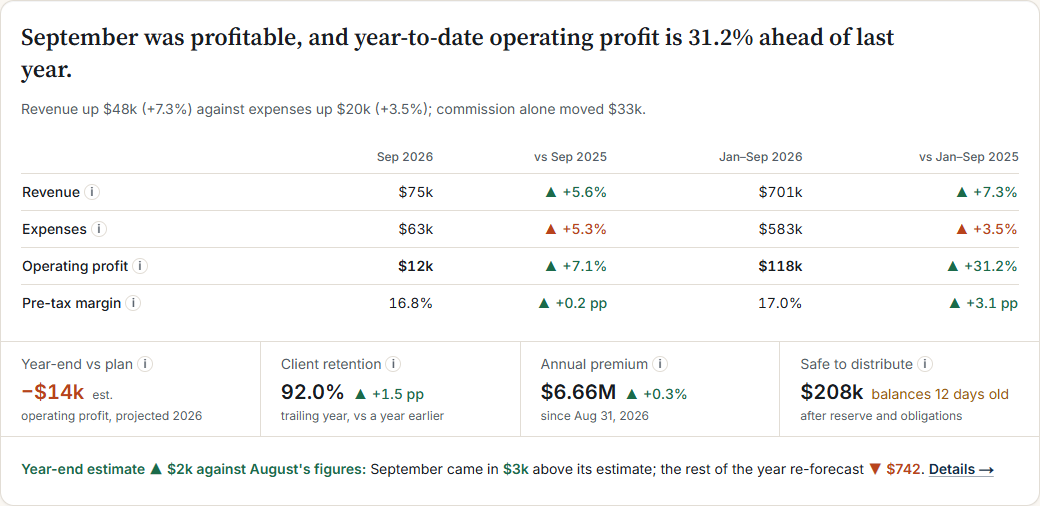
After the month closes, the brief says how it went. In the demo: September was profitable, and operating profit for the year to date is 31.2% ahead of last year. Below the verdict sit revenue, expenses, operating profit and margin for the month and the year, then year-end against plan, client retention, annual premium and cash.
Further down, the brief ranks the issues for the meeting to settle, each with the profit, plan or book story behind it. A reader can save a decision and a dated follow-up on each issue, and next month's brief brings it back. It prepares the meeting; it assigns no tasks and sends no reminders.
Open the Monthly brief in the live demo →See a sample brief (PDF) →
Owner viewOpen this page in the live demo →
Is revenue turning into profit?
Where: Agency Performance, Financials, P&L. Financials opens on Overview, with ten headline measures.
Follow revenue to net revenue, through expenses to EBITDA, then to operating profit and net income. In the demo, year to date through September: $701k of revenue, $142k of EBITDA, $118k of operating profit. Compare the same months last year, then open the accounts behind a change.
Budget, under Planning, sets actual results against the plan by month, year to date and full year. The question is whether the year is landing where you planned, and which difference needs a closer look.
Ask the next question. “Are we more profitable, or just generating more revenue?” The Keelridge Assistant answers from the figures your role can see and links the answer to its source.
See the recorded fictional answer →Explore this owner P&L in the live demo → Owner viewOpen this page in the live demo →
Look at the book behind the result.
Where: Agency Performance, Book, Growth.
Growth takes the opening book to the closing book: what left with lost clients and dropped lines, what the rest renewed at, and what arrived as new clients and new lines. In the demo, the book went from $6.28M to $6.66M over the twelve months to September 30. New business of $831k more than replaced the $677k that left: 122.7% of it.
This answers a different question from booked revenue. It describes the in-force book between two dated AMS snapshots, and premium growth alone does not show that the agency won more business.
See the public book premium bridge →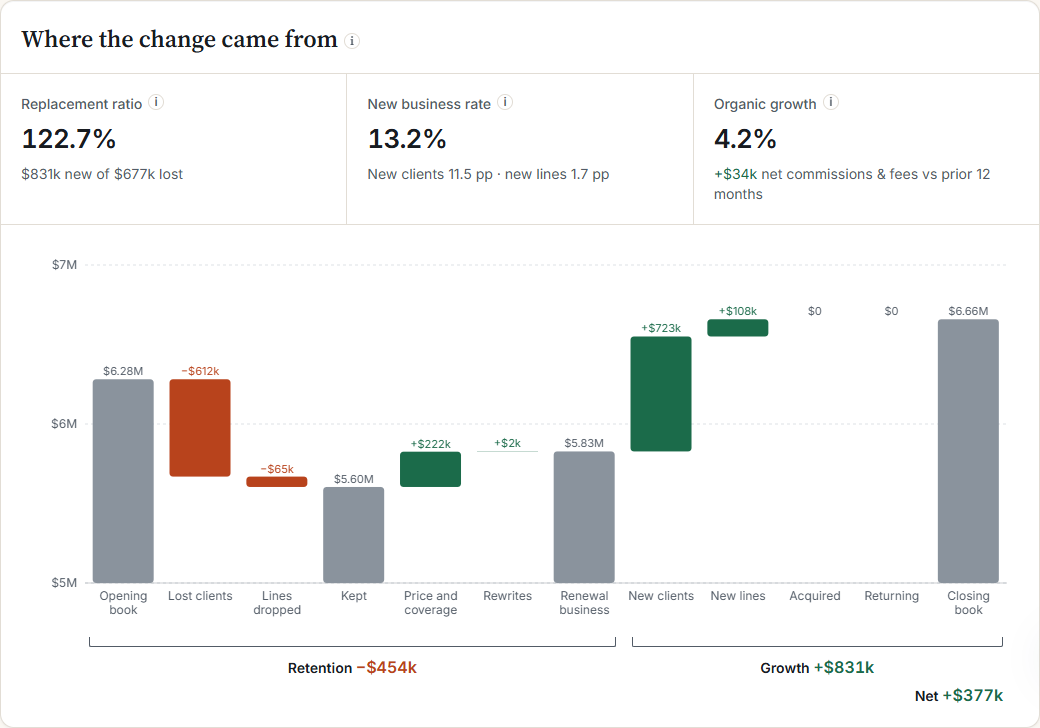 Owner viewOpen this page in the live demo →
How much of last year's book renewed?
Where: Agency Performance, Book, Retention.
Client retention counts each of last year's clients once. Premium and commission retention are renewal business over last year's book: what is left after lost clients and dropped lines, at this year's price. They can pass 100% when prices rise. In the demo, for the same twelve months: 92.0% of clients retained, 92.8% of premium and 93.0% of commission renewed.
The premium figure is the Growth page's renewal business, $5.83M, over its opening book, $6.28M. The premium retained before rate and exposure is $5.60M, or 89%: lower than client retention, so the clients who left were larger than average. A policy rewritten to the same coverage, or moved to another carrier, is retained; only its price change counts.
Why the two retention measures disagree → Owner viewOpen this page in the live demo →
Do the book and the P&L tell the same story?
Where: Agency Performance, Financials, Book vs GL.
Keelridge sets twelve months of booked P&C commission beside the book's annual commission averaged over the same months. In the demo, the twelve months to September 2026: the ledger booked $858k, the book's annual commission averaged $862k and is $887k today. Growth of $25k is shown on its own.
The $4k left between booked commission and the average is Timing & unexplained; on the picture it is the −$4k marker, 0.5% of booked. It stays visible rather than being forced into a cause the records do not prove. Direct-bill modeling and six-month annualization stay disclosed inside annual commission; contingency and other income stay outside the comparison.
See the complete commission-income explanation → Owner viewOpen this page in the live demo →
Carry the review into the next meeting.
After setup, the owner, or someone the owner authorizes, uploads supported reports, reviews the checks and confirms the update. A monthly review is a useful rhythm; files can be refreshed whenever supported reports are available. The owner does not have to collect several account-manager reports and retype every input before the conversation can begin.
Read the brief, open the pages behind it and settle its questions. Managers and account teams use the views their roles allow; the brief does not route findings into tasks.
See how Keelridge handles sources and boundaries →Before acting on the result
Use the figures with the right context.
- Keep the source and period attached.Every useful figure should name its source, period and basis.
- Leave unresolved differences visible.A remainder is a question for the review, not permission to invent an explanation.
- Correct records in their source systems.Policy, client, transaction and accounting corrections stay in the system that owns them.
- Keep sensitive economics with the right roles.Department managers and account managers see premium within their scope, not commission or payout figures.
Questions from agency owners
Before using the review in your agency.
What should an independent insurance agency owner include in a monthly financial review?
Start with the month's result: revenue, expenses and profit against the same period last year and against the plan. Then look at the book behind it: what you kept, what renewed at a new price and what new business arrived. Finish with whether the book and the ledger tell the same story, and a short list of questions for the meeting to settle.
What information does Keelridge need?
A supported book-of-business export and usable income statements or approved accounting reports, whether accounting lives in the AMS or a separate system. Setup maps and checks the actual reports, definitions and roles. After that, the owner, or someone the owner authorizes, uploads supported updates and confirms the checks before the figures refresh. A monthly review is a useful rhythm, not an upload limit.
Can I ask follow-up questions without rebuilding the review?
Yes. The Keelridge Assistant answers supported questions in plain English from the figures your role can see, and links each answer to its source. It is read-only; people interpret the answer and decide what follows. The Product page includes a recorded fictional answer, and you can try a few questions in the public demo.
Does Keelridge replace the AMS or accounting system?
No. The AMS remains the system of record for policies, clients, service history and insurance transactions; accounting remains the record of posted financial activity. Keelridge compares and explains those sources without silently making them agree.
Your agency’s management review
Bring the financial questions you need to answer.
Keelridge is free for five design partners until February 15, 2027. It starts with a 20-minute fit call, where we walk through Keelridge using fictional agency data. Discuss the review you assemble today and the questions that take another round of work. No agency files are needed for the conversation.