
Operations · Notes
What should an independent insurance agency owner review every month?
Short answerReview the month's profit against last year and the plan, then the book behind it: what you kept, what renewed at a new price and what new business arrived. Add what is coming due and whether the book and the ledger tell the same story. End with a short list of questions to settle. No single KPI gives the whole picture.

John RanieriFounder & Product Lead, Keelridge SoftwareSeptember 10, 2026 · 6 min read
Which questions belong in the monthly review?
Start with questions, not a wall of metrics. The review should explain what changed, separate the causes and pick out the few items that need follow-up.
| Owner question | Main figures | What to review |
|---|---|---|
| Did the agency make money? | The closed accounting month | Revenue, expenses, operating profit and EBITDA against the same months last year |
| Are we on plan? | The approved budget | Actual against plan by month, year to date and full year, and where the year is heading |
| Did the book grow, and why? | Dated AMS book snapshots | Opening and closing premium, lost clients and dropped lines, rate and exposure, rewrites, and new business |
| Did we keep the clients we started with? | Last year's book followed to the ending date | Client retention, and premium and commission retention as renewal business over last year's book |
| What is coming due? | Current AMS policies and renewal dates | Renewal load, large premium changes at the last renewal, and the accounts to review early |
| Is new business producing real growth? | Opportunity records and AMS arrivals | Opportunities that came in, were bound or were lost, beside new clients and new lines in the book |
| Do the book and the ledger tell the same story? | A year of booked P&C commission and the book's annual commission over the same months | Growth to today, and the signed difference left over |
| How do we compare with the best agencies our size? | A completed year of net revenue and the industry study | Organic growth, margins and the Rule of 20 against the Best Practices Study for your revenue band |
| Did the books we bought pay back? | Deal facts, the acquired books' clients and the mapped ledger accounts | Whether the bought clients are staying, what each book leaves the agency, and payback against the price |
Why does a complete review need more than one reporting basis?
An agency management system holds the record of clients, policies, carriers, premium, renewal dates and expected commission. Some AMS platforms also hold the accounts. Even in one platform, a book snapshot, posted accounting, the budget and cash describe different parts of the business.
The accounts show revenue, expenses and profit. Knowing which clients stayed, what renewed at a new price, what arrived and who owns an upcoming renewal takes the book and its assignments.
So a reliable owner review puts these sources around management questions, whether they come from one platform or several. Each figure keeps its source and period.
How can an owner build a useful first version by hand?
A spreadsheet can work as a start if the agency uses the same process every month. The discipline matters more than the design.
- Name the period. Decide which closed accounting month and which dated AMS snapshot the review uses. Do not mix a current book with an older P&L without saying so.
- Keep the original exports. Save the files used for the review, so a surprising figure can be traced instead of rebuilt from memory.
- Freeze the definitions. Decide what counts as a client, a lost client, a dropped line, a rewrite, new business, a hand-over and a large premium change before comparing months. The metric definitions give one set.
- Bridge the book. Separate clients who left, what the rest renewed at, and what arrived: new clients, new lines and any books you bought.
- Compare rather than force. Set a year of booked P&C commission beside the book's average annual commission over those same months. Show growth to today separately and leave the difference visible until the records explain it. The commission note walks through it.
- Write down the questions. End with the few renewals, exceptions or questions the meeting should settle, and who will look into each.
Which time periods should an agency compare?
Use the closed month to spot recent movement, year to date to see progress through the year, and the same months last year to separate seasonality from a real change. A trailing twelve months helps with run rates, but do not label it year to date.
Both sides need the same definitions. If one period counts bought clients as new business, or uses a different commission assumption, the trend may be a change of rules rather than of results.
How should the review turn numbers into work?
An owner should not leave with twenty charts to remember. The review should end with a short list of questions: which result needs an explanation, which book movement needs a closer look, which renewal needs early attention, and who will look into each.
Owners, department managers and account managers do not need the same screens. The owner needs the agency's economics and movement. A manager needs the team's books and renewals. An account manager needs their own renewals, premium changes and book, without the agency's financials.
Those views can come from the same records, each showing only what the role needs.
What does the Monthly brief do?
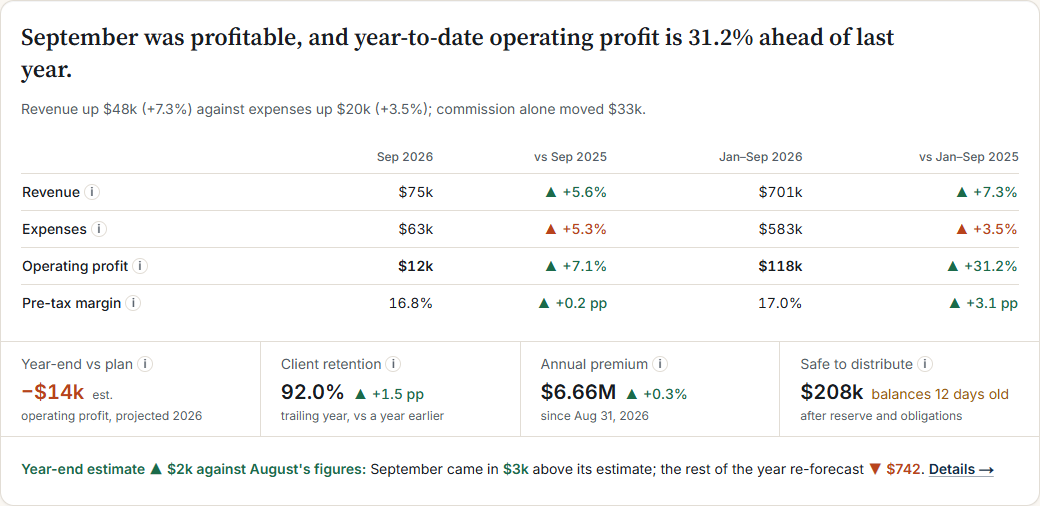
In Keelridge the owner's first page is the Monthly brief, the landing page of Agency Performance. After the month closes it says how the month went: a one-line verdict, then revenue, expenses, operating profit and margin against last year, for the month and the year to date.
Below that comes a ranked list of issues for the meeting to settle, with three shown and more on request, each with the profit, plan or book story that explains it. Then what is going well, what to watch next month, and last month's follow-ups.
The brief prepares the leadership meeting. A reader can save a decision and a dated follow-up on each issue, and next month's brief brings it back with whether the issue is still flagged. It assigns no tasks, sends no reminders and does not measure what a decision achieved; it is not the agency's official record of decisions. The page itself makes no AI call: its findings come from rules over the figures it shows.
See a sample Monthly brief (PDF).
What does Keelridge remove from the process?
The arithmetic is rarely the hard part. Finding the inputs, coping with changing report formats, keeping client identity consistent, applying the same definitions and rebuilding the comparisons every month is the recurring work.
During setup, Keelridge maps the supported reports, definitions, roles and book assignments. After that, the agency supplies its regular AMS book and accounting files; each is checked before it updates the figures. Keelridge then writes the Monthly brief from those figures, by rules, so the questions above arrive answered and the owner does not collect separate account-manager reports.
The AMS and accounting system remain the systems of record. Keelridge organizes the review around them, keeps the differences between them visible, and gives owners, managers and account managers the view their role needs.
What the owner sees first
The Monthly brief: how the month went, before the detail.
 Owner viewOpen this page in the live demo →
Fictional Keelridge Demo Agency, September 2026. The brief opens with the month's verdict, then revenue, expenses, operating profit and margin against last year for the month and the year to date, with year-end against plan, client retention and annual premium below.
How movement stays explainable
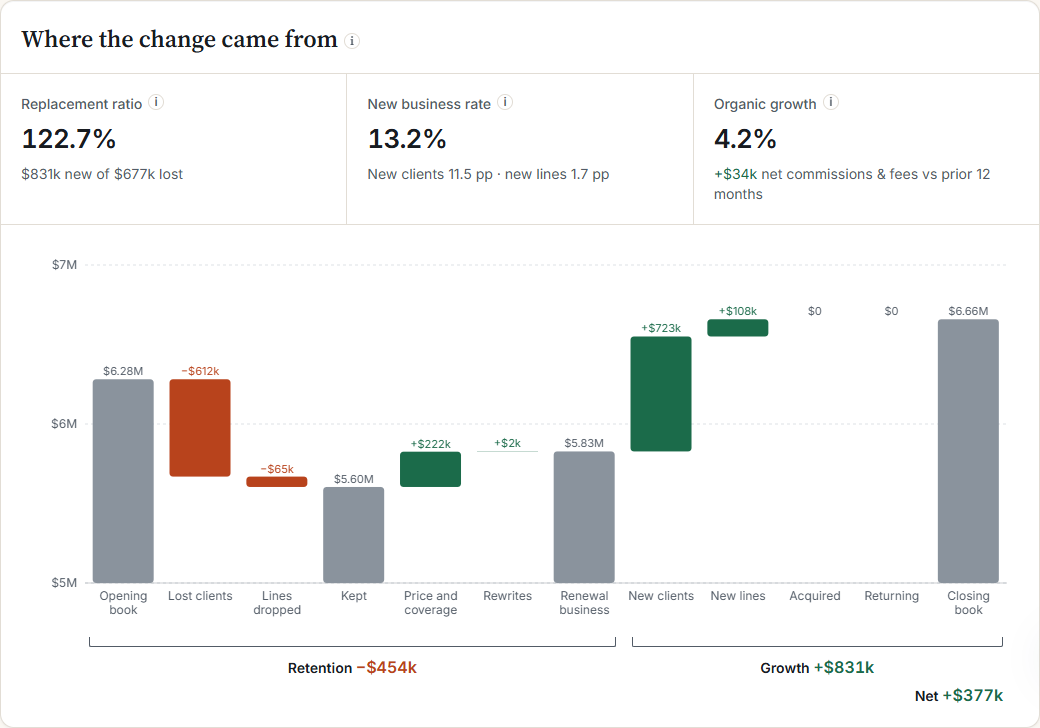
Growth is separated into what left, what renewed at a new price and what arrived.
 Owner viewOpen this page in the live demo →
Fictional Keelridge Demo Agency, twelve months to September 30, 2026. The Growth page keeps rate and exposure changes on renewed policies apart from new business.
Start with the questions, not new dashboards
Use one closed accounting month and one dated AMS book, answer the owner questions on a consistent basis, and write down what still needs explaining. If preparing those answers depends on several people, repeated exports or a workbook only one person understands, the preparation is the problem to solve, not the lack of another KPI.