
Guided account-team tour · 5 steps
See how assigned books are developing
Bring client retention, premium renewed, growth, net cross-sell and new business into one team review. See what changed in each book, check the context and agree where people need support, without rebuilding separate reports before each conversation.
KEELRIDGE SOFTWARE · REVIEWED · Screens come from a fictional, read-only agency.
 Department manager viewOpen this page in the live demo →
The short answer
One team review. Better questions for the conversation.
Where are assigned books changing?
Start with the team, the period and what each role is responsible for. Read client retention, premium renewed, growth and new business together.
What deserves a closer conversation?
Follow a change into its definition and context. Check hand-overs, bought business and the account manager’s explanation before drawing a conclusion.
Where does the team need support?
Bring workload and service quality into the conversation. People agree on coaching or follow-up and return to the figures in the next review.
Which books and responsibilities are we reviewing?
Where: My Book, Performance, My team for a department manager; Agency Performance, Team for the owner.
Start with each person's book, the period and what each role is responsible for. Current book size describes scale; the review needs retention, growth and hand-over history to explain what changed.
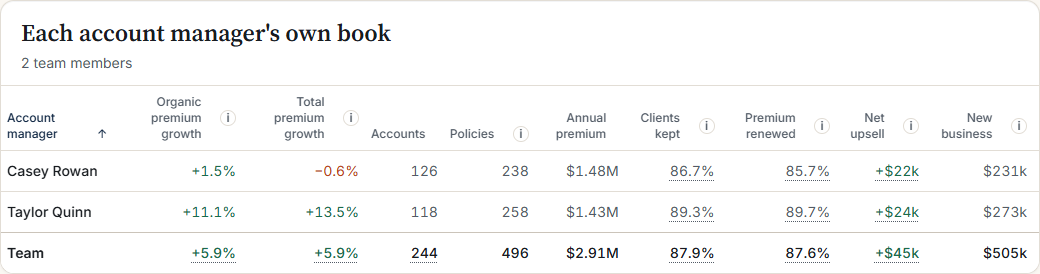
The department manager's view lists each account manager on one table for the same twelve months: organic and total premium growth, client retention, premium renewed, net cross-sell and new business. No commission. Use it to find the questions worth asking and the people who may need support.
Explore the team view as Department Manager →
Department manager viewOpen this page in the live demo →
What was moved or bought, not sold?
On the same table, organic premium growth leaves out clients handed over between colleagues and purchased policies in their first 12 months. Total premium growth leaves them in. The gap between the two columns is what was moved onto that book or bought for it, not sold into it.
A hand-over moves a client at last year's value. It changes who looks after the business without creating growth or loss for the agency. Start with the same person over equivalent periods. Book size, mix, complexity, tenure, carrier changes and transfer history remain context for any comparison.
Read the complete measurement method →
Department manager viewOpen this page in the live demo →
Are relationships staying and developing?
Read the columns together. They answer different questions: whether clients stayed, how much of the book renewed at a new price, whether new business arrived, and whether clients on the book added more than they dropped.
Client retention counts last year's clients still here. Premium renewed is each person's renewal business over the book they serviced: what they held a year ago, plus or less any clients handed over, at last year's value. Rate and exposure changes count. A client lost after a hand-over counts for the person who received it; one lost before it counts for the person who handed it over.
Read New and lost business alongside it. New business is new clients and new lines; rewrites, bought books and lines back after a gap in the records are not. Net cross-sell is new lines less lines dropped. The book's premium gives scale.
The Keelridge Assistant supports investigation of authorized figures within the reader’s role scope.
Compare the team outcomes in the live demo →
Department manager viewOpen this page in the live demo →
What does the account manager see in their own book?
Where: My Book, Performance.
An account manager's My Book opens on Performance: clients, policies and premium, then Premium renewed, Client retention, New business, Accounts rounded and Policies per client, each against last year, and this year's target where a manager has set one. In the demo, this account manager rounded 7 accounts and holds 2.19 policies per client. Commission, agency-wide financials, and peer comparisons stay outside that view. Their own figures give the account manager a starting point for the conversation.
Explore the fictional account-manager perspective → Account manager viewOpen this page in the live demo →
Agree on support. Return to the figures.
After initial mapping, each supported report is checked and confirmed before the team review updates. Managers can return to consistent periods and definitions without rebuilding several account-manager reports before every meeting.
Use the conversation to agree where coaching, coverage or follow-up would help. People own those actions and return authoritative insurance activity to the AMS. A monthly review is a useful rhythm; supported source uploads are not limited to once a month.
See how recurring sources become a review →Before drawing a conclusion
Put the book figures in context.
- Check the period and assigned scope.Read each result with its definitions and the book responsibility it describes.
- Investigate the signal with the team.An unexpected change in client retention, premium renewed or rounding can point to a useful conversation.
- Account for influences beyond one person.Rates, carriers, producers, staffing, acquisitions and source quality also shape the result. The figures alone do not establish employee causation.
- Respect the role’s access.Department managers and account managers see premium within their scope, not commission or payout figures.
- Keep the whole review human-owned.Service quality, communication, judgment, workload and role expectations belong alongside the numbers. Metrics do not create an employee score, decide compensation or automatically assign work.
Questions from agency owners
Before using account manager metrics in your agency.
What are the best KPIs for an insurance account manager?
Read client retention and premium renewed, new business, net cross-sell, rounding and the book's premium together. New business is new clients and new lines; rewrites, bought books and lines back after a gap in the records are not. Bring hand-overs, role expectations, workload and service quality into the conversation. Department managers and account managers see premium within their scope, not commission or payout figures.
Read the note →Should an insurance agency rank account managers against one another?
A direct ranking is rarely fair unless the books have comparable size, mix, complexity, tenure, and transfer history. Start with each person's trend over the same prior-year period, then use the team view to identify questions for coaching rather than to create an automatic verdict.
How can an agency calculate account manager performance every month?
After setup, the owner, or someone the owner authorizes, uploads supported AMS reports, reviews the checks and confirms each update. Shared definitions connect the owner, team and own-book reviews, with different permissions. Supported questions can be investigated with the Keelridge Assistant within the reader's authorized scope. The public demo answers a few questions on the fictional agency.
Can account manager metrics determine compensation or bonuses?
Not by themselves. Compensation decisions also require a defined role, measures the employee can influence, transparent formulas, workload and service-quality context, and management judgment. Book analytics can support that review; they should not make the decision automatically.
The review your team needs
Bring your account-team questions.
Keelridge is free for five design partners until February 15, 2027. It starts with a 20-minute fit call, where we walk through Keelridge using fictional agency data. Discuss how you review assigned books today and what managers and account teams need to understand. No agency files are needed for the conversation.